Social Media

Tim on Twitter


No, not me.  I’m highlighting an interesting post on a very cool blog that I just discovered from Tim Berry, President and founder of Palo Alto Software on the nature of Twitter. 

Tim argues Twitter can be a good thing or a bad thing.  At its best, it is a game-changing business must-have for every serious marketer.   At its worst, Twitter is time-wasting drivel.  In the end, however, it’s neither.  It all boiled down to how you use it.

I think we’ve all caught ourselves in that moment of shock waking up from a Twitter bender having just spent more time that we’d like to admit on the “bad” Twitter. 

Tim Berry’s Synthesis: “Twitter is the brush, not the painting. It’s a tool for a new kind of self publishing with a different kind of reach. Talk of business benefits of Twitter are like talk of business benefits of the telephone, or of conversation, or of advertising. It’s all in how you use it. Who or what are you trying to be in Twitter, and what does that have to do with your identity, your message, your business, your self.”

How are using your brush?

Read more of Tim’s interesting blog at: http://timberry.bplans.com/2010/12/twitter-is-the-brush-not-the-painting.html#ixzz188ajPUqj

Standard
Marketing, Sales, Social Media

Are You LinkedIn?


I had the pleasure of co-facilitating a workshop on LinkedIn this week.  There were more than 20 people in the room with varying degrees of familiarity with the LinkedIn platform.  It was a fun event, and we received some great feedback on the usefulness of the tool, particularly for these folks, many of whom are in a job search.

They say you never learn something until you teach it.  What I learned was just how far this platform has come in the past 6 months.  As an early adopter, I sometimes take it for granted.  But seeing it through the eyes of a newcomer really highlighted just how powerful this tool set is.

LinkedIn is:

  • Your Personal website.  It’s YOU.com (just Google yourself and see)
  • Your LIVING Rolodex (it grows exponentially as you nurture it)
  • A “P [professional] RM” System  (moves with you from job to job)
  • A Social Media Platform  (hooks into Twitter, “like”, “sharing,” etc.)
  • A Database of Corporate Information (“Company” entity added)
  • A Job Posting / Search System (powerful for recruiters /job-seekers)

If you (or anyone you care about) are still not on LinkedIn, you need to get on pronto.  If you are a power user, it’s time to take a look at the new features available to you.   LinkedIn has centralized some very useful training information in a section called “The Learning Center” http://learn.linkedin.com/ where you can quickly update your knowledge and skills.

Get to it!

Standard
Sales

Before Proposing – ALWAYS Ask for a Meeting


Here is a little pre-Thanksgiving humor for my sales compatriots out there courtesy of Scott Adams.  If you’ve ever been in this sales situation, you’ll get a kick out of the Dilbert strip above.  Scott has a great site by the way, where you can buy relevant strips for your marketing efforts.

So what’s the lesson here? I have given up on responding to vague and/or rushed RFPs, and I would recommend you do the same.  If the prospective client is not willing to sit down with you and work through some basic questions that will allow you to craft a response both more accurate and relevant to them, you’re probably column-fodder on their spreadsheet anyway.

I can’t tell you how many times early in my career I took valuable time (in some cases all night) responding to a long RFP for which I knew in the pit of my stomach we had no prayer of winning.

Now, asking for the “pre-proposal discovery meeting” has become a valuable step in qualifying the opportunity before burning the resources to craft a solution and response.

Don’t let your Pointy Haired Boss make you work all day Thursday unless you have had your meeting.

Happy Thanksgiving!

Standard
Marketing, Sales

2010 = Rearview Mirror – How To Start on 2011…


 According to Chad White, research director at Responsys and author of the Retail Email Blog, as of Oct. 29, 57% of top online retailers had begun their holiday email marketing campaigns.

The holidays are upon us.  Retailers are in full swing.  People are making final Thanksgiving preparations with their guests. 

If you are in B2B marketing or sales, and you don’t have active opportunities rolling deep into your sales funnel by now – you’re too late for 2010. 

Whether or not you hit the mark this year,  you need to be building your base for 2011.  In B2B sales and marketing, this the time of year to book your last deals and focus on building a foundation for January and beyond.

So what do I recommend?

1.  Lock down schedules.  For any business that you book between now and yearend, time will get tighter by the week to get things done for the executives, legal departments, and other parties to your deals.  Get your calendars locked with confirmed calendar responses so your time remains sacrosanct.

2. Say “Thank You.”   Press the flesh.  Take this opportunity to say thank you to your good clients and even your solid prospects for the good business and future business.  Schedule some time for coffee or lunch to cath up and discuss next year.  Buying is an emotional decision, This does make a difference.

3.  Execute holiday campaigns flawlessly and ferociously.  While it may seem counter-intuitive, messages arriving during this time can have a higher hit-rate because your clients in B2B businesses have the same lull now.  Their in boxes are quieter over the next 2 months, and they are in the office more.

4.  Plan your marketing calendar for Q1 and Q2 2011.  Do it now, so you can spend your time January on execution , not dallying with a plan.

5.  Clean House.  Use this time between the holidays to catch up, clean up, and focus. Toss old files, clean out (and back up) your hard-drive.  Do all the things you never have the time to get to during normal business months.

That’s All, Folks!   On to 2011!

Standard
Social Media

Social Monetization and Social Ubiquity


…That is Denise E. Zimmerman, president and chief strategy officer at NetPlus Marketing Inc. with one of the most eloquent synthesis I have heard bundling the important trends happening in social media today.

Many of us are processing social media’s evolution through the tools that we are using: blogs, twitter, LinkedIn, Facebook, etc. but seldom stepping back and viewing the forest for the trees.  It is a very valuable exercise.

Denise shares her vision of these “ubertrends” in her recent article published today in iMedia Connection, “Social media trends to watch for 2011.”  

Social Monetization, she says,  is the use of social apps that drive revenue and ROI.  Social Ubiquity is the proliferation and convergence of the social web.

These two ubertrends and the subtrends that comprise them are driving much of what we’re living through in social media today.

This article is a great read and frames some of the issues of the day (including privacy) in a larger context.  You should definitely give it a try.

Standard
Marketing, Sales

Throw Away Your Sales Funnel


In the past five years, as the internet explosion spilled over from technology  hobbyists into full use by the general public, and finally adoption by the business world, it added velocity to a trend that I would argue was already underway  – the death of sales.

Sounds ominous (and a bit like a play starring Dustin Hoffman) but it’s true. The traditional sales approach is dead.

As a career sales rep and process wonk who for many years has practiced and studied both sales and marketing processes, I have analyzed my fair share of process models. For many decades, the conventional thinking in this area focused on affecting or acting on the customer, “selling them,” “generating demand,” ” qualifying them,” etc.

Your buyers have rendered this approach irrelevant. The consumer is now in charge of both the initiation and pace of the sales and marketing processes. No room in this post to argue that fact, so if you’re struggling with it, just take a leap of faith and read on.

Organizations that understand this new buyer-driven reality can capitalize on the new model and thrive, but not with the same old funnel.

You have to abandon the traditional sales funnel (generate leads, qualify opportunity, propose, close) and adopt one that manages the new reality.

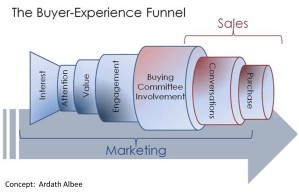
The ways in which authors and analysts are depicting the traditional sales and marketing funnel model is also changing (finally). I ran across one particular funnel that really impressed me. I think it is dead-on.

Ardath Albee, an emarketing expert and author you should check out immediately, has conceived a funnel that truly addresses today’s sales and marketing realities. I have included an image of it in this post.

You’ll first notice that it is a horizontal funnel. This is brilliant way to visually depict that the process is not one of seller throwing buyer into a hopper to be squeezed and refined as if by gravity into a sale, but one of myriad, opt-in choices that the prospective buyer must be attracted to in the marketplace. It fully acknowledges that content and value attract buyers.

The model then goes on to show a largely buyer-driven process (acknowledging that business buyers rarely act alone but rather in committees or teams). Only then do we see some traditional selling tenants kick in, and even they are more collaborative in nature.

You should definitely check this model out. Here is a link to Ardath’s blog entry for more information.

By the way, Ardath also wrote a book called “eMarketing Strategies for the Complex Sale” which explains her philosophy on creating the unique and nurturing content that will attract your buyers to the front end of this funnel.  I’m currently reading it and will post more on this topic in later posts.

Standard
Marketing, Social Media

What’s your Digital Lung Power?


It’s an interesting way to think about the effectiveness and reach of your presence online.  How loudly can you be heard ?  Are you just a whisper – not connected through anything but an stale, partly filled-out profile on LinkedIn?  Or, are you a force to be heard – connected not only through LinkedIn, but perhaps a blog, TwitterFacebook, and the many other outlets available  in your industry or areas of interest to richly share your thoughts online? 

Want to do a quick exam of your digital lungs?  Just type your name into www.google.com and see what comes back.  

Then you should take some steps to ensure the patient isn’t barely breathing.

Standard
Sales

Sales Team Meeting – A Shot in the Arm


Got together with my national sales team last week. It was an extremely valuable exchange of ideas.

When was the last time you gathered your sales team together for a face to face?  For us, it had been too long.

These meetings (when properly planned and executed) are so valuable you really need to do them annually at a minimum.  What type of value do you get?

  1. Comrodarie: More than putting faces with the names, you realize that you are not in this alone. Others are struggling and succeeding with you, through the same obstacles and leveraging the same resources.
  2. Best Practices Exchange: There is no better way to make a “best rep = all reps” changes than getting the entire team together to interact in person. You all learn more than you bargained for – guaranteed.
  3. Process Improvement: When you get the whole team to surround a problem, you can make not only incremental changes but also take some quantum leaps because you are all there for consensus to action.
  4. Energy Boost: You leave with a shot in the arm. You leave with the energy of just having met with an incredibly talented team of people and a sense of the overall goal. You feel like storming the field.

The day that we all arrived home, each and every rep connected with me to say it was a great investment of their time and that they learned a lot.  They look forward to attacking the rest of the year.

So when was your last sales meeting? 

More importantly, when is your next one?

Standard
Marketing, Sales, Social Media

Are You Content Marketing?


If you are marketing today and not doing so through organized publicity of your intellectual capital through Content Marketing, you’re missing the boat!

Before you jump in, there are a few things you need to know:

  1. It’s a LOT HARDER THAN YOU THINK!   This takes planning, organizational alignment, rigorous scheduling, and new processes to start,  and – most importantly –  discipline to maintain.
  2. It’s a LOT SIMPLER THAN YOU THINK!  The tools available to support your efforts in this area were simply inconceivable only a few years ago.  Now they enable you to do this complex job more efficiently and effectively.
  3. It’s about WILL POWER!  Focus and tenacity are the hurdles here.  If you have them, you can be winning with content marketing in very short order.

What are the benefits?  “Brand Stickiness,” “Google Juice,” – whatever you want to call it, will bring recognition>leads>business!

The graph displayed here is an image from an excellent research piece done by Roy Young of  Marketing Profs and Joe Pulizzi of  Junta 42 “(B2B Content Marketing, 2010 Benchmarks, Budgets and Trends” [download here] that will give you an overview of the major components of a content marketing effort, along with some very useful statistics.

Some highlights:

  • Nine out of 10 B2B marketers are using content marketing to grow their businesses.
  • Enthusiasm for content marketing is high; however, marketers are still unsure about the effectiveness and impact
  • Content marketing deployment is high across industries, with no single industry reporting below 78% adoption
  • Web traffic is the most widely used success metric (56%) followed by direct sales (49%)
  • On average, B2B marketers allocate approximately 26% of their total budgets to content marketing initiatives
  • The largest challenge is “producing the kind of content that engages prospects and customers” (36% of respondents
  • Social media and article posting are the most popular tactics and are currently used by 79% and 78% of B2B marketers

Get this paper and digest it today!

Standard
Marketing

A Call For Expertise in Preparation


If you’ve read this blog you know I’m a huge fan of Seth Godin.  His posts really make marketers think about the job we’re doing.   It’s probably the best blog out there for marketing professionals, and Seth is very economical with his words.

Yesterday he posed a particularly provocative thought on preparation.  The challenge is to think about the level of effort and expertise you are applying to your preparation.  Basically, are you a pusher or a leaner?

He argues there are three levels of preparation: “Beginner,” “Novice,” and “Expert.”  Basic premise:  Most of us languish in the novice stage and never push hard enough to reach expertise.

As sales and marketing professionals, we can take this to heart in many areas:  Go-To-Market Planning, Pre-Meeting Planning, Product Development, Websites and other marketing efforts.  Do you ever find yourself phoning it in?  Why start if you’re not going for something brilliant?

Standard
Social Media

Jeff Bullas’ Top 5 Posts…


I’ve sung the praises of Jeff Bullas in past posts.  If you’re not following him on Twitter, it’s your loss.  Pound for pound, it’s the best social media direction I’ve found out there.

Here is an interesting post of his from this summer.  It is from his blog readers’ perspective.  The focus is what they have found “most newsworthy and topical in the last 90 days.” 

Summary:

  1. 30 Things You Should Not Share On Social Media
  2. The 7 Secrets to Ford’s Social Media Marketing Success
  3. 20 Things You Should Share On Social Media
  4. Twitter Reveals 11 New Facts on its Traffic and Usage
  5. How To Use Twitter For Business: 5 More Incredibly Interesting Case Studies

As usual, great stuff.  Thanks, Jeff!

Standard
Sales, Uncategorized

“I Love It When A Plan Comes Together”


We tend to wander when we don’t have a destination.

The topic is Sales Account Planning.  Not the most thrilling subject – until your account plan starts bearing fruit!  Then you feel like a genious who’s master plan is coming together.  In the words of Hannibal from The A-Team, “I love it when a plan comes together!”

And yet, it seems to me that Account Planning is a threatened species in today’s business world.  What might be some driving factors?

  1. Today, the buyer is a co-owner of the cycle.  The Seller not longer controls information.  The Buyer controls and equal share.  So, how can the seller propose to pre-determine where he or she will sell their next deal?  Hint:  the ones who carefully choose their targets still can!
  2. It’s risky today to call your shots, and people are more risk-averse in this economy than ever.  It is much safer to chase the next RFP that comes through email than to aim and fire where everyone knows you’re shooting.  Hint:  It’s worth the risk.  You will miss some, but you’ll hit more by aiming than by blind shotgun blasts into the dark.
  3.  It’s a lot of work.  Once you lay out an org chart and determine “I’m going to map this in the next quarter,”  you have a lot of work to do.  Who’s got the time?  Hint:  Hard work is goo for you – and – social media and network accelerators like LinkedIn can make this relationship mapping go exponentially faster than it used to!
  4. It takes too much time.  If I take a few hours to write a plan, I’m not in the field selling!  Hint:  a few hours invested in this activity will help you avoid many hours of wasted time chasing bad business like RFPs, hunting in the wrong vertical markets, etc.  Focus your work on the 20% of your effort that pays 80% of your bills. 
  5. It’s too formal.  “We just do things more ad-hoc around here.”  Hint:  Good, then you be safe and ad-hoc in there, and I’ll get more business out here!

If you decide to see the wisdom and start account planning, remember that your plan should be a living document.  It should  predict as best it can the context of your prospect or client, but evovle over time.  “No battle plan ever survives contact with the enemy.” — Field Marshall Helmuth Carl Bernard von Moltke.  Meaning, your plan is going to change!

Whatever form your account plans take, you need to be doing this.  There is no better way to create your future in sales.

What do you think about account planning?  How do you do it in your organization?  More on this topic in future posts.

Standard
Social Media

If We All Had These Core Values…


While reading another fantastic blog post by Jeff Bullas  (who if you don’t follow on Twitter you must – as he highlights and summarizes some of the most interesting concepts in social media marketing today)   I ran across this summary of the 10 core values driving the online shoe retailer Zappos.  Jeff’s focus was linking these values to  ways in which social media reinforces the culture and the success of Zappos, and it’s a great post. 

I’m still just processing this list (for the first time) on a simpler level.  I am simply struck at how different these values are from most of the generic, boring, homogenized core values in corporate America.   While reading them I asked myself (and urge you to do the same) how much better would my (or any) company be if we focused on these unique values?

Have a look and let me know your thoughts.  Here is a link and the list:  

  • Deliver WOW Through Service
  • Embrace and Drive Change
  • Create Fun and A Little Weirdness
  • Be Adventurous, Creative, and Open-Minded
  • Pursue Growth and Learning
  • Build Open and Honest Relationships With Communication
  • Build a Positive Team and Family Spirit
  • Do More With Less
  • Be Passionate and Determined
  • Be Humble
  • Standard
    Sales

    The Two-Year Sales Cycle That Proves Nurturing Works


    Yesterday, I had the satisfaction of closing a sale on which I’d been working for over two years.  I can’t describe the feeling better than to say this is why you get into sales!

    A two-year sales cycle is crazy!” you say?  I would submit that it is more the norm these days when you look at the total life of a deal.  As you can imagine this represented the culmination of many, many touch points with my client.

    In their outstanding book “Professional Services Marketing,” the partners at Wellesley Hills Group espouse the concept of “Nurturing.”  I could not agree more.  As mentioned in the book, the “long sales cycle” equals the months and even years that it takes to foster a strong relationship while the client builds to a point where they have a real initiative and funding and are thus in active buying mode. The concept is that the “short sales cycle,” once the client is able to buy, is much shorter – perhaps only several weeks. 

    But you need to focus on the nurturing that puts you in a position on the long-cycles so when that buyer is ready, you are a trusted source for solutions and the obvious choice.

    What are you doing to stay in front of your highest priority customers monthly, or even weekly, to nurture your way to more sales?

    Standard
    Marketing, Social Media

    Jet (Black and) Blue Pushes Back…


    Fresh from the front pages…

    Unless you’re dead or off the power grid, you may have heard the story of the flight attendant turned emergency-ramp-escapee Steven Slater, a huge PR fiasco for Jet Blue exploding all over the internet.

    But, as covered in a Fast Company article by David Zax this morning,  in a sign that major companies are learning to flex their new social media muscles to leverage perception in the marketplace and not just be ruled by it, Jet Blue responded in a simple blog entry that many are crediting for turning the tide on their perceived role in this mess. 

    Think of it – for virtually NO COST – and in a few pithy sentences, a major up-and-coming airline changed the prevailing winds of public perception fueled by a (albeit completely overblown) major news story.

    That’s an interesting power that did not exist even 24 months ago

    Please lower your tray tables, fasten your seatbelts, and prepare for takeoff…

    Standard
    Marketing, Social Media

    Do Your Executives and Social Media Mix?


    How engaged in your social media efforts are your executives?  If you are like most of us, the answer is…not very.  But why is that?  Here is some great perspective from Erik Qualman.  He takes an interesting angle on social media in his post published yesterday:  Social Media and Executives Don’t Mix.   This post is Qualman’s summary of a great source post by the social media firm DemingHill.   It asks you to think about  social media from the executive’s perspective.  It is an interesting way to calculate the social media quotient at your company.   Qualman takes these lessons away from DemingHill’s (excellent but longer) post on why senior execs often don’t like social media:

    1. Lack of understanding = fear. The rapid rate of change in digital innovation has caused CEOs to feel extremely vulnerable around technology.
    2.  I want control. I want to control my company! I want to control my brand! I want to determine my destiny! It’s too important to leave it to chance (or simply be outvoted by the uninformed bourgeois)!
    3. Fear that it’s a fad. The truth is, I would love to commit to social media in a significant way, but so far nobody in my organization has stepped forward with a cerebral, strategic, multigenerational, integrated, systematic, and sustainable methodology and roadmap for synergistically capitalizing on this medium over the long haul.

    So why should executives get behind the momentum of social media efforts in their marketing mix?  The authors suggest a few good reasons that include:  unfiltered feedback from the market, authenticity-“keeping it real,” and the fact that it’s a powerful but relatively low-cost marketing approach. 

    Check out the posts from the links above and see what you think.

    Standard
    Social Media

    Marketers to Spend $220 Million on Ads in Social Games This Year


    http://bit.ly/crV3zP RT @eMarketer:

    Personally, I don’t like these things. Who’s got time to play games? However, as a student of the art of social media, I do keep up on Facebook and see MANY of my contacts playing “Farmville”, etc. so I guess there’s an audience for it.

    What’s been your experience?  What do you think of online games as a marketing tool?

    Standard